
Investors and startup executives are calling for extending the period for an entity to be recognised as a startup from 10 to 15 years for deep-tech companies.

Prime Minister Narendra Modi inaugurated the Northeast's first Emergency Landing Facility in Assam, boosting regional defense and disaster response capabilities.

Sanjay Malhotra has made structural changes to banking regulation to bring down costs and increase efficiency. Plus, he kicked off a benign interest regime. But there are challenges ahead.

India's corporate bond market, driven by public sector undertaking (PSU) banks and financial institutions last year, is losing momentum since the second quarter of FY26.

'Vigilance' is a dreaded term for PSB employees and there are instances where this fear is misused by the higher authorities to tame their subordinate officials. This fear always deters PSB executives from making decisions -- the fewer the decisions, the less the chance of falling into trouble, points out Tamal Bandyopadhyay.

Investors should tilt their portfolios towards domestic-facing defensive sectors, which should help provide stability and shield them from geopolitical and tariff risks.

'AI analyses body language, etiquette, and communication skills, providing an in-depth performance matrix and a ranking system to help employees identify areas of improvement.'

For over a decade, HDFC Bank consistently outperformed industry growth rates in both deposits and advances, maintaining impeccable asset quality. Amid a landscape where other banks struggled with soaring non-performing assets (NPAs), HDFC Bank thrived, eventually surpassing ICICI Bank to become the largest private sector lender in India. Its net interest margin (NIM) remained stable in the range of 4.1-4.4 per cent.
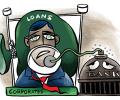
Public-sector banks (PSBs) in Q3FY23 wrote off bad loans worth Rs 29,000 crore, up from Rs 23,000 crore in the same quarter a year ago, as part of a clean-up exercise. According to estimates by rating agency CARE Ratings, the write-offs by PSBs in April-December 2022, at Rs 81,000 crore, were lower than the Rs 90,000 crore in April-December 2021. Sanjay Agarwal, senior director, CARE Ratings, said a lot of it was driven by regulations, and assets that had 100 per cent provision coverage were written off.
Telecom firm Bharti Airtel will approach the government on the adjusted gross revenue (AGR) it has to pay the exchequer following the Supreme Court's judgment that the government can reassess all AGR dues, according to vice-chairman and managing director Gopal Vittal.

Your promise to protect bankers for their commercial decisions is a huge confidence booster, but how does one define a commercial decision? Are our investigative agencies well equipped to dissect lending decisions of bankers?

UPI has catapulted India into the forefront on the global digital payments landscape. Working hand in hand, the AePS payments system is making life easy for rural folks, notes Tamal Bandyopadhyay.

'In the long run, India's strong growth story and reforms to make assets globally attractive will determine the rupee's resilience.'

We propose an expert group be set up to form a national strategy on digital fraud. This group would bring together skills in financial regulation, security economics, cyber defence, and public communications, and an understanding of the Indian financial and security systems. It should lay the foundations of a coordinated approach by the Indian State in fighting digital fraud, suggest Ajay Shah and Nandkumar Saravade.

Three laws passed in Parliament could boost central revenues, reshape GST cess flows, shift MGNREGA costs to states and create new budget headroom ahead of the 2026-2027 Union Budget, points out A K Bhattacharya.

Top losers in the Sensex pack included ICICI Bank, Tata Steel, Vedanta, HDFC IndusInd Bank, Tata Motors, RIL and ONGC -- falling up to 4.45 per cent.

IPOs have been the flavour of the season for some time. But the coming together of three mega IPOs, from diverse businesses and historic relevance, could tell a story that's still in the making, points out Nivedita Mookerji.

Axis Bank and ICICI Bank consumed 37-59 per cent of their operating profit for COVID-19 provisioning, while the figure is 24 per cent in case of Kotak Mahindra Bank and 10-12 per cent for IndusInd Bank and HDFC Bank.

In fact, some private sector lenders have decided to skip advertising these altogether.

The rally followed the govt's plan to bolster state-owned lenders.

What is currently perceived as a massive, low-tech liability could become a high-value, export-oriented economic engine, points out Ajit Balakrishnan.

CEA offers three compelling arguments in his case for privatisation of government-owned banks.
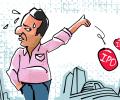
'The primary market's rhythm mirrors investor confidence. While sentiment may appear cautious, it reflects maturity, not weakness.'

Finance Minister Nirmala Sitharaman on Wednesday asked fintech startups to come out with solutions to deal with the rising incidence of digital arrests, cheating by fly-by-night operators, and other kinds of cyber frauds. Speaking at the Digital Payments Awards 2025 ceremony here, the minister credited fintechs with helping speed up financial inclusion and taking the payment system to even the far-flung areas of the country.

'We are in a position to start due diligence and private data room access shortly.'

Of the three major Budget announcements related to the banking sector, privatisation of PSBs is the most audacious, says Tamal Bandyopadhyay.

In the Sensex pack, IndusInd Bank was the top gainer, soaring around 8 per cent, followed by Bajaj Finance, Axis Bank, PowerGrid, ONGC, ICICI Bank, Sun Pharma and M&M.

'The pricing model will be different. The product will be different.'
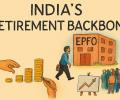
A 10-part series that explains all you want to know about how India's EPF turns a slice of your monthly salary into long-term savings, pension, and life insurance.
Private sector lender ICICI Bank has revised its external benchmark lending rate (EBLR) to 8.10 per cent, and state-owned Bank of Baroda has raised the rate to 6.90 per cent with immediate effect after the RBI hiked the key repo rate. Likewise, two other public sector banks -- Bank of India and Central Bank of India -- have also raised the repo linked lending rate. In an out of turn Monetary Committee Meeting (MPC), the Reserve Bank on Wednesday announced to hike the benchmark repo rate -- the short term lending rate it charges to banks -- by 0.40 per cent to 4.40 per cent with immediate effect, aimed at taming the rising inflation caused by the global geopolitical situation.

Bank credit is likely to grow at a four-year high of 11-12 per cent in fiscal 2023, on the back of better economic growth and budgetary support from the government, according to a report. In the fiscal ended March 2022, bank advances have likely grown at 9-10 per cent. "Healthy economic growth and budgetary support from the government should lift bank credit growth by 200-300 basis points to 11-12 per cent this fiscal," Crisil Ratings said in the report. The higher credit growth expectation is also supported by the improved resilience of the banking system, it added.
Experts hail 2014 as the worst year for banks.

The more things change, the more they remain the same for corporate India. In the April-June 2025 period (Q1FY26) - for the ninth consecutive quarter - listed companies witnessed only single-digit revenue growth, while their core earnings, excluding other income and one-time gains, contracted for the second time in four quarters. This comes as firms brace for the impact of 50 per cent US tariff on Indian goods.

Not all public sector banks are back in the black, but their collective net profit for the year is Rs 32,346 crore against a Rs 9,013 crore loss in the previous year, points out Tamal Bandyopadhyay.

The governor made it clear that the RBI is aware of what's happening and acts accordingly, but doesn't make a noise about that, points out Tamal Bandyopadhyay.

Losers included Bharti Airtel, SBI, Wipro, Vedanta, Maruti Suzuki, ICICI Bank, Axis Bank and Reliance Industries, falling up to 2.18 per cent.

'Amaravati will be a game changer for Andhra Pradesh.'

'What do the moves towards protectionism suggest?' 'That we do not have Aatmavishwas.' 'If you have self-confidence, confidence in your ability to compete with the best in the world, why do you need protectionism?'

Prime Minister Narendra Modi on Friday sounded the poll bugle in Bihar, where assembly elections are due this year, calling for 'an NDA government, once again', which would protect the state from the 'evil intentions' of the Rashtriya Janata Dal-Congress combine.

There is a need for real-time or near real-time credit reporting, instead of the current fortnightly system, to improve underwriting precision, enable timely reflection of borrower actions such as loan closures or repayments, and deliver a superior consumer experience, Deputy Governor of the Reserve Bank of India (RBI), M Rajeshwar Rao said on Wednesday.
